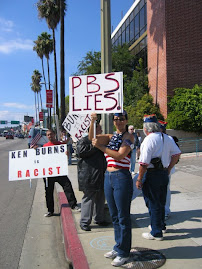
Cars and pickup trucks roamed the intersection of Fifth and C Streets to affirm the students’ cause with repeated honks, blaring banda music, and the deafening revving of V8 engines. The students responded with hoots while pumping their pawky placards and Mexican colors. School administrators and teachers protectively observed the youth as did boomers like me, Gen Xers, and millennials—yes millennials you are no longer young.

The righteous indignation of students continued into the night on Oxnard’s Saviers Road. As part of the protest, cars cruised this thoroughfare, as in the late 1970s, brandishing even more Mexican flags. Others lined up along the road. One galled covey burned the US flag.
This rage is largely rooted in the Magabrones jingoism against their immigrant peers, family, and barrio neighbors. Hence, burning the US flag in protest disgruntles foes and friends alike. For me, I’m cool with the burning of the US flag in protest as I know, as a Marine Corps veteran, that most of the sacrifices made by men, women, and theys in uniform were made under pretexts of defense dating back to the US attack on Mexico in 1846, to the 1899 Boxer Rebellion in China, conquering Hawaii, colonizing the Philippines, Vietnam, and Iraq, to name a few. These wars were to expand US capital abroad, not to protect our freedoms at home.
Nonetheless, flag burning adds to the scrappiness of social movements which is fundamentally democratic.
The next day, Saturday, February 1st, another demonstration erupted. I could not witness this one as I was out of town.
After seeing social media posts by Oxnard High and Ventura College MEChA clubs Sunday morning, I drove to la placita. One started at 11 am and the other at noon. I arrived on time, but the turnout was meager at first as my people have a reputation for arriving more than “fashionably late.” But by 1:00 pm the hoi polloi grew to over 1,000. Aztec danzantes extended their imprimatur with their arrival and ceremony. The Chicana/o+ event included gringos, Blacks, as well as flag-pumping Guatemalans, Hondurans, and El Salvadorans.
I thought the protests would cease until the next weekend. But they continued in Oxnard, Santa Paula, Fillmore, and throughout Southern California as part of a Monday Day Without a Mexican boycott of public institutions and businesses. They’re still popping up. There’s even one planned in the sleepy Ventura County community of Ojai, Saturday, February 8th at Libby Park starting at 11 am. Be there or be square.
As in the 1976 movie NETWORK, my people are mad as hell and they’re not going to take Magabrone animus and Little-Hands Trump’s bullying anymore.

Similar to the street demonstrations against racist schools throughout the Southwest and the Vietnam War, where the Mexican American casualty rate was disproportionate to their population in the Southwest, during the 1960s and ’70s, the youth of today seized the mantle of resistance to debut their generation’s power. Supported by elders of diverse ages, races, and ethnicities. To paraphrase the famous history teacher of East LA, Sal Castro, after the student walkouts of 1968, it’s a beautiful time to be a Chicana/o+—of Mexican, Guatemalan, Honduran, El Salvadoran, and other origins of Nuestra America!
Social media posts indicate that these protests are part of an inchoate social movement. The resistance will be victorious in stopping Dirty Don’s racist mass deportations. This was the result of the 2006 Gran Marchas that metastasized throughout the nation’s cities and communities that stiff-armed H.R.4437, authored by congressman James Sensenbrenner; a presumed slam-dunk piece of legislation before the infantry of Nuestra America defiantly took to the streets in mass, essentially saying “You xenophobes want a fight, you got one.”
And make no mistake, the assault of Don the Con and his Magabrones on immigrants makes no distinction between the criminal, undocumented, documented, long-time or short-time resident, naturalized or US-born citizen, the Black or Brown of varying shades, from Haiti to Venezuela, as well as those born in East L.A. We are all considered a suspect class subject to arrest and deportation.
 A colleague in academe and former CSU Channel Islands student of mine, at Oxnard’s placita, Sunday, February 2, 2025

By taking to the streets flapping the banners of the origins of their communities, the protestors are saying chinga tu maga—Magabrones take a long walk on a short peer. Out of the shadows, they are also saying to Trump’s Gestapo, “Bring it on.” We are going to resist you with the full support of our elders (many veteranas/os of el movimiento), lawyers, educators, service workers, and other brothers, sisters, and theys in the trades and other industries. Aqui Estamos Y No Nos Vamos—We’re Not Going Anywhere.

On the flag waving of Mexico’s tri-colors, Chicano-gonzo journalist, Gustavo Arellano perspicaciously penned in 2016 (and recently updated):
Waving the Mexican flag isn’t just a shout-out to their ethnic heritage; it’s a blatant reminder of the failings of this country toward comprehensive immigration reform. Because if there’s anyone to blame for the Mexican-flag flap, it’s conservatives. As I’ve been saying for over a decade, Mexicans assimilate into America, yet many Americans don’t want to believe it and want to do anything possible to stop it. Talk to those kids waving the bandera, and their culture is wholly American, from their language to fashion stylings to music, upbringing—their everything. But when you have morons calling their parents and elder relatives rapists and murderers, and call young Mexican-Americans unworthy of the U.S. and want 11 million undocumented folks deported, wrapping themselves in the Mexican flag is a righteous chinga tu madre to the white supremacy that wants them gone (and, yes, Virginia: Trump-supporting minorities can subscribe to white supremacy, too—know your decolonial imaginary!).
Take it from this pocho. Gustavo is spot on.
Spanish-speaking people of Nuestra America have been under attack since, if not before, 1846 when the US, in its violent westward expansionist tradition, declared war against Mexico to steal its territories of Alta California, Nuevo Mexico, Tejas, Colorado, and Nevada. It would have conquered all of Mexico if not for its white supremacist leadership, especially Southern slaveholders like South Carolina Senator John C. Calhoun (aka, the pro-slavery Fire-Eater) concerned with a replacement theory of the time, as today, opposed to the incorporation of more Brown people into the nation’s fold replacing the numerical power of whites.
In 1849, Henry David Thoreau, in Civil Disobedience, censured this war, as did Illinois congressman Abraham Lincoln, along with an antagonism to the nation’s enslavement of Black people and the inexorable extermination of Native Americans. Students of Nuestra America learn these truths in the Chicana/o+ histories instructed by veterana/o college MEChistas who are now educators and advisors of MEChA clubs in high schools and colleges. From their study of settler colonial treatises of Manifest Destiny, Chicana/o+ students, and other colonized peoples of the Global South, compare themselves to Palestinians as our lands have been similarly stolen from us by terrorist Puritans and pioneers, Texas Rangers, vigilantes, and a pro-capitalist US legal system. They have studied the works of Chicana/o+ scholars who have documented these truths, largely, unaddressed in mainstream US history courses, that censor our autochthonous heritage and deceitfully label Raza, our people, as alien. As protest placards state about the US invasion of Mexico and its northern territories in 1846, “We Did Not Cross the Border. The Border Crossed Us.”
 Student walkout at Oxnard High School, Friday, January 31, 2025

Chicana/o+ peoples will not be erased from the land and history. Analogous to our Palestinian camaradas, in and out of Palestine, our numbers are growing. Such data unhinges replacement theory-obsessed Magabrones.
At the Sunday demonstration, I reconnected with a former student who is now a high school counselor and co-advisor of her campus’s MEChA club. I asked her how Chicana/o Studies manifests in the protest. She responded that Chicana/o Studies teaches our students that this attack on our immigrant community is not new. We, as a people, have been to this rodeo before and have persevered through the racism initiated in 1929 at the start of the Great Depression, Operation Wetback of the 1950s (how much more racist could this epithet, coined by US leaders, be), California governor Pete Wilson’s chauvinistic promotion of Proposition 187, and the failed congressional Republican attempt to charge with felonies undocumented immigrants and their allies under H.R. 4437 in 2006. These assaults on our immigrant communities did not erase us; instead, they amplified our resolve and numbers.
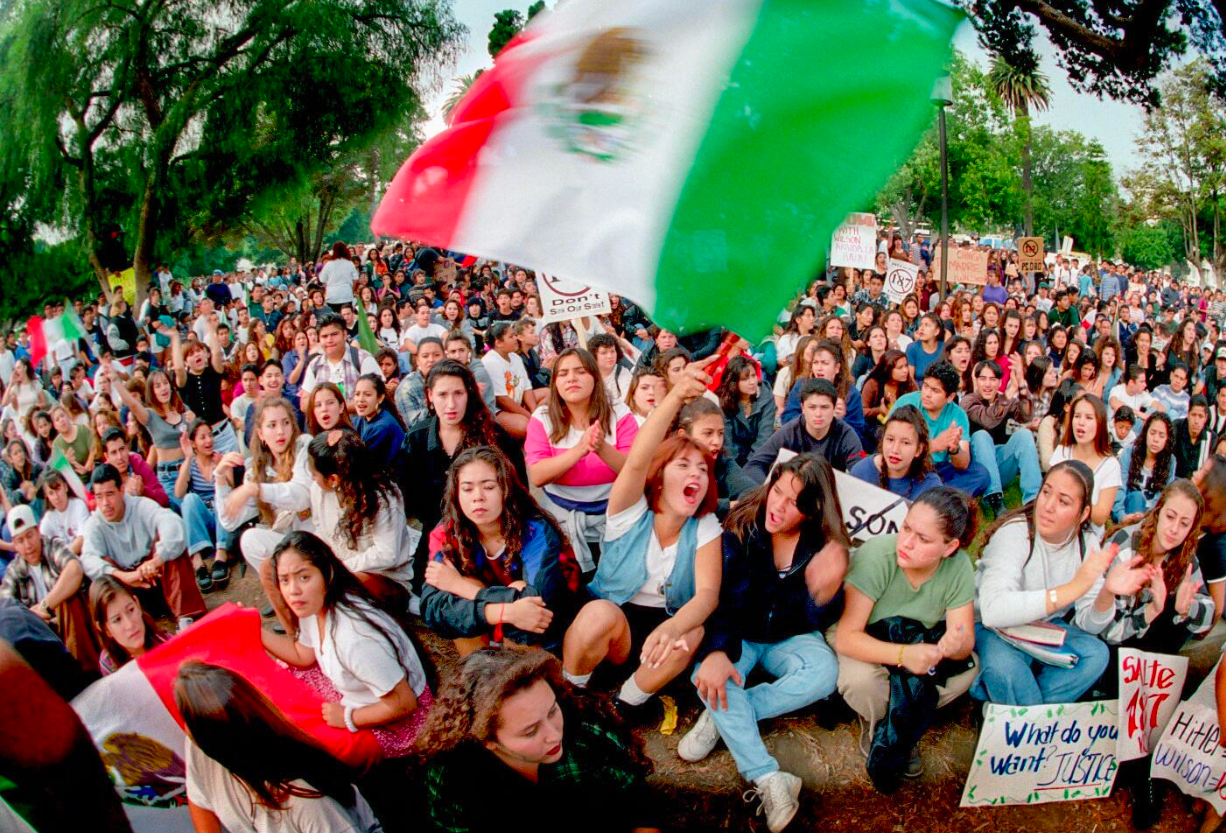
Furthermore, my former student stated that Chicana/o Studies teaches us to defend and provide succor to each other—politically, legally, socially, and in terms of our mental health—as a community in solidarity with other communities also under parallel attack.
Venceremos.